
▶ PRIMARY FINDING
An unprecedented, coordinated multi-front offensive by an unlikely operational alliance of Al-Qaeda affiliate JNIM and Tuareg nationalist FLA forces decapitated Mali's military leadership in April 2026, pushing the Russian-backed junta toward structural collapse.
The offensive exposed three compounding failure modes simultaneously: command decapitation, geographic overextension, and the failure of the "Russian security guarantee" supplied by Africa Corps (formerly Wagner Group).
I. ANATOMY OF THE OFFENSIVE
Multi-Front Strike Architecture
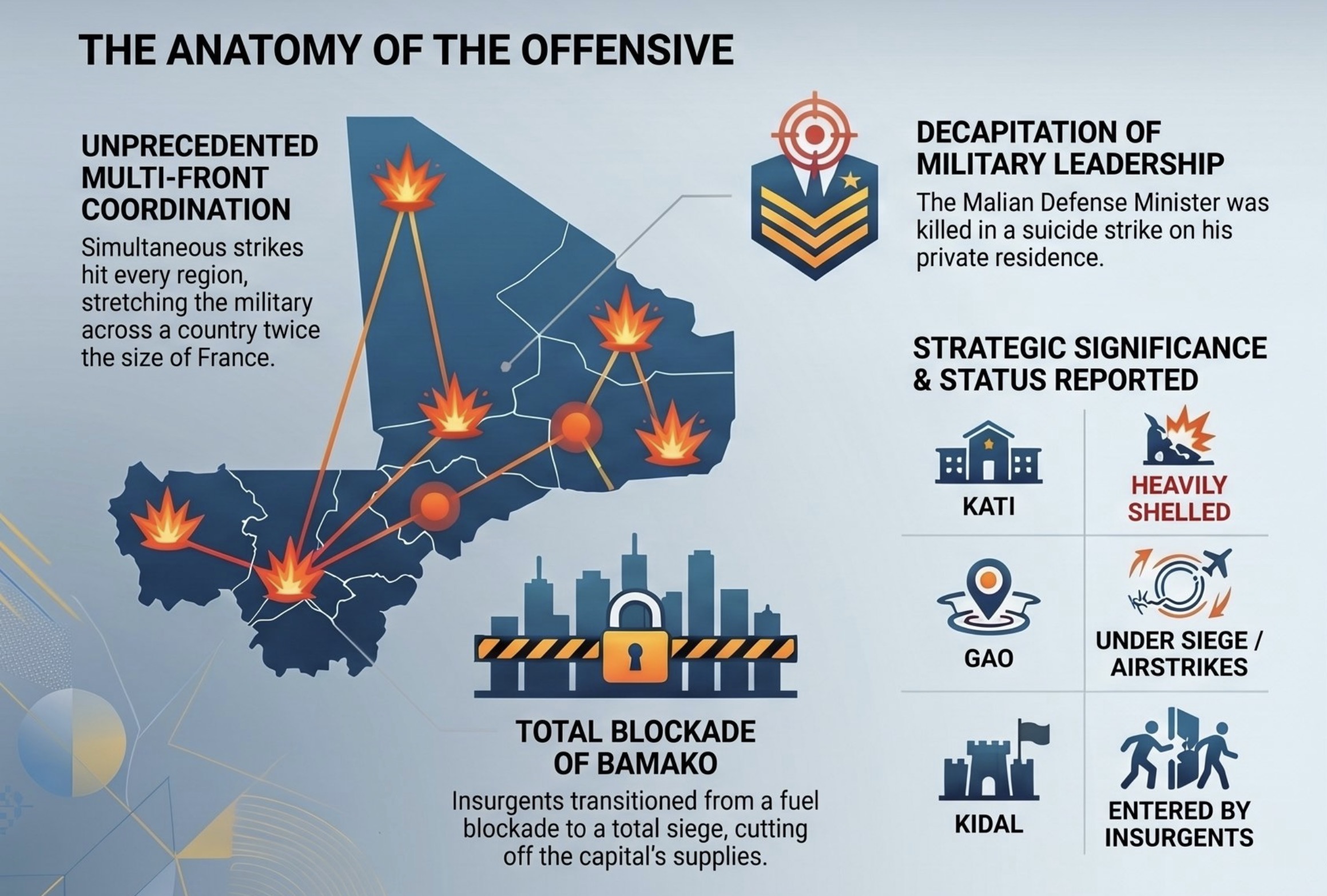
01
Total Blockade of Bamako
Fuel blockade transitioned to full capital siege
02
Kati Military Base
Garrison town; primary command infrastructure
03
Gao (Northeast)
Strategic northeast corridor; airstrikes reported
04
Kidal (North)
Historic rebel stronghold; insurgent entry confirmed
+
All Regions Simultaneously Targeted
Stretched forces across a country twice the size of France
Command Decapitation Event
● Primary Strike
Malian Defense Minister Killed
Suicide strike on private residence. Command structure decapitated at the apex of crisis.
Junta Status
On Edge of Collapse
Russian-backed military government destabilized
Coordination Level
Unprecedented
Simultaneous regional + capital strikes
STRATEGIC SIGNIFICANCE
▸ Operational Coordination
Multi-front synchronization across a 1.24M km² theater indicates sophisticated inter-group command and control, representing a step-change in insurgent operational capacity.
▸ Intelligence Penetration
A strike on the Defense Minister's private residence implies significant intelligence penetration of state security protocols, compromising force protection at the highest level.
▸ Legitimacy Vacuum
Command decapitation concurrent with territorial siege operations maximizes the probability of governance collapse by removing both leadership capacity and territorial control simultaneously.
II. DRIVERS OF STATE COLLAPSE
The JNIM-FLA "Pragmatic Alliance"
Jihadist Affiliate
JNIM
Al-Qaeda in the Islamic Maghreb (AQIM) franchise. Sahelian operational reach.
Operational Alliance
Separatist Nationalists
FLA
Tuareg nationalist forces. Longstanding territorial grievance actors.
■ Structural Logic
Ideologically opposed groups suspended internecine competition to concentrate pressure on the Bamako central government. This type of convergent opportunism is a recognized pre-collapse accelerant in fragile state environments.
■ Intelligence Implication
The alliance likely represents a time-bounded operational arrangement rather than ideological convergence. Fracture risk increases as government pressure weakens, but short-term coordination capacity remains high.
■ Historical Parallel
The 2012 Tuareg-AQIM coordination that captured Kidal and Gao followed a comparable tactical logic. The 2026 iteration is broader in geographic scope and higher in command targeting ambition.
The Russian Security Guarantee: Failure Analysis
■ Africa Corps Performance
Africa Corps (formerly Wagner Group) forces were numerically overmatched by simultaneous multi-front pressure. Rather than holding assigned positions, units negotiated tactical withdrawals. The force's stated deterrence function failed at scale.
■ Strategic Miscalculation
Russian security doctrine in the Sahel relied on visible force presence as deterrence. The offensive demonstrated that insurgent operational planners had correctly assessed this doctrine's limitations against a coordinated, geographically distributed attack architecture.
■ Reputational Consequences
Negotiated withdrawals, rather than combat defense, degrade Africa Corps' commercial security narrative across the Sahel client network. Mali's collapse would constitute the most significant failure of the Russian military-commercial security model in Africa.
HUMAN COST INDICATOR
■ Population Alienation Driver
State and Russian forces being linked to 77% of civilian fatalities prior to the offensive constitutes a compounding legitimacy crisis. It provides JNIM and FLA with a narrative of protection and grievance redress that directly undermines junta support mobilization capacity.
III. SYSTEMIC ASSESSMENT
Collapse Cascade: Three Simultaneous System Failures
■ SYSTEM FAILURE 01
Command Decapitation
The assassination of the Defense Minister removed the apex of strategic decision-making at the moment of peak operational pressure. Reconstitution under combat conditions is operationally improbable in the short term.
■ SYSTEM FAILURE 02
Territorial Overextension
Simultaneous strikes across all national regions exhausted force reserves. A military sized for sequential threat response cannot absorb synchronous multi-front pressure without catastrophic force dilution. The geographic scale — a country twice the size of France — amplifies this constraint.
■ SYSTEM FAILURE 03
Security Guarantee Collapse
Africa Corps' negotiated withdrawals rather than position defense removed the external deterrence mechanism the junta had substituted for indigenous military capacity. The Russian model's failure leaves the junta without a viable military backstop at its most critical hour.
Analytic Assessment: The concurrent activation of all three failure modes constitutes a structural convergence that no single policy or security intervention can rapidly reverse. Junta survival in the near term depends on whether any one failure mode can be arrested before cascade effects become self-reinforcing.